
Three main causes of Exocrine Pancreatic Insufficiency in dogs are-
- Pancreatic Acinar Atrophy (PAA), which is an inherited disease causing a gradual loss of enzyme-producing cells.
- 1a. Pancreatic Acinar Atrophy used to be considered an autosomal recessive condition in dogs: Note: This has been challenged recently, though, and it’s important to know that research is being done into it being a Polygenic condition, which means it may be influenced by multiple genes, rather than a single gene.
- Chronic Pancreatitis (CP), which is an inflammatory condition that damages the pancreas.
- Pancreatic Neoplasia (cancer), which can disrupt normal pancreatic function.
Inherited EPI is developed via an autosomal recessive gene: 50% of each dog’s genetic traits are shared, and you will have a 1 in 4 ratio in a litter, depending on which gene is shared. Note: In dogs, an autosomal recessive gene means a specific gene for a genetic condition that is located on a non-sex chromosome and requires TWO copies of the mutated gene-ONE from EACH parent – for the dog to be affected by the disorder. A dog with only one copy of the mutated gene is called a carrier; it does not show signs of the disease but can pass the gene on to its offspring.
PLEASE NOTE: There is currently NO health test available that can advise you if a stud dog or Dam is a carrier of the EPI gene creating PAA – (inherited EPI). You will only know when the TWO dogs produce EPI puppies!! Neither of these parent dogs should be bred again, as you will not know if a new partner is carrying the affected gene, and ethically, you wouldn’t want to create more EPI puppies.
Key terms and concepts:
Autosomal: The gene is found on one of the numbered, non-sex chromosomes, rather than the X or Y sex chromosomes.
Recessive: For the disorder to develop, a dog MUST inherit two copies of the mutated gene.
Carrier: A dog that has one copy of the recessive, mutated gene but does not show any signs of the disease.
Homozygous recessive: A dog that has two copies of the mutated gene and is therefore affected by the disorder.
Age of diagnosis – Dogs with hereditary exocrine pancreatic insufficiency (PAA) are often diagnosed in German Shepherds and Rough Collies and typically present at a younger age (often under 4 years old) than other breeds. While EPI can affect dogs at any age, the onset of signs for PAA-related hereditary EPI is most common in young adulthood, 2-3 years old.
Other breeds: While EPI can occur in any breed, it tends to appear in middle-aged to older dogs when the cause is chronic pancreatitis rather than PAA.
Why the Age Variation? Pancreatic Acinar Atrophy (PAA): The most common cause of hereditary EPI is PAA, which is a genetic condition where the pancreas deteriorates. It can take up to four years for the pancreas to completely stop working, but most are fully dysfunctional by 2.5 – 3 years old.
Chronic Pancreatitis: In some cases, EPI results from chronic inflammation and damage to the pancreas, a condition that can affect dogs of any age but is often seen in middle-aged to older dogs.
Understanding Genetic Results in Dogs
Clear, Carrier & Affected Explained
Many inherited conditions in dogs (including those seen in German Shepherd Dogs) follow an autosomal recessive inheritance pattern. Understanding how this works helps breeders make informed, responsible decisions that protect puppy welfare while maintaining genetic diversity.
What patterns do genes usually follow:
🟢 Clear (Normal / Normal)
- The dog does not carry the faulty gene.
- The dog will not develop the condition.
- The dog cannot pass the gene on to offspring.
🟡 Carrier (Normal / Affected)
- The dog carries one copy of the faulty gene.
- The dog is not affected and will live a normal life.
- The dog can pass the gene on to offspring.
🔴 Affected (Affected / Affected)
- The dog has two copies of the faulty gene.
- The dog will develop the condition.
- The dog will pass the gene on to all offspring.
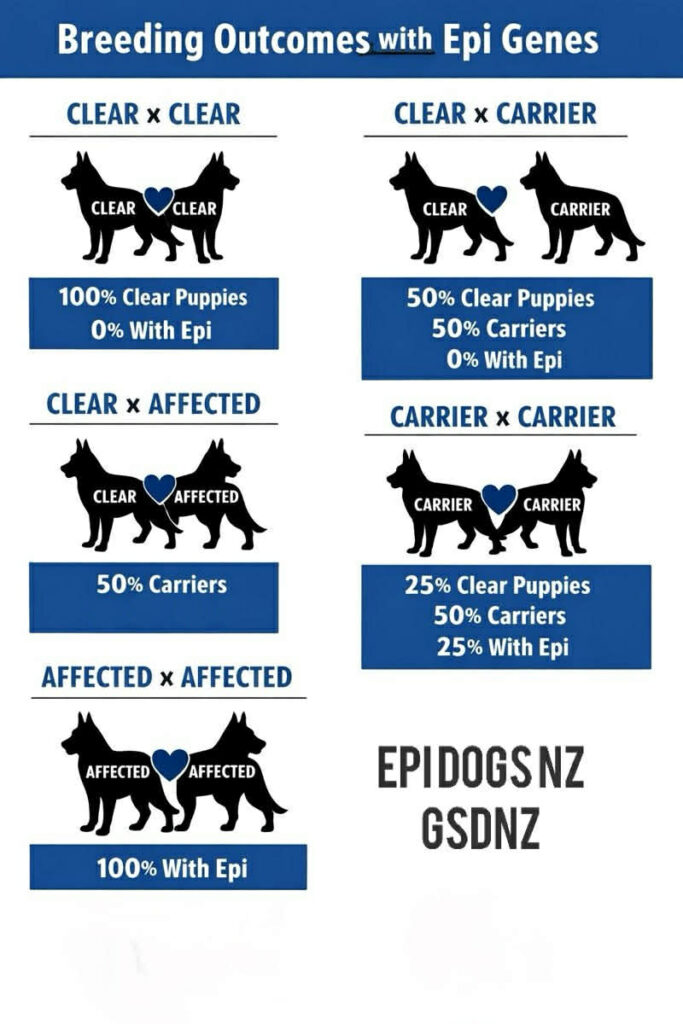
How genes are passed to puppies
Each parent passes one copy of the gene to each puppy.
The combination a puppy receives determines whether it will be clear, a carrier, or affected.
Breeding combinations & expected outcomes
Clear × Clear
- 100% Clear puppies
- No carriers, no affected pups
✔️ Ideal match
Clear × Carrier
- 50% Clear
- 50% Carriers
- 0% Affected
✔️ Acceptable with responsible planning
Carrier × Carrier
- 25% Clear
- 50% Carriers
- 25% Affected
⚠️ High risk – affected puppies expected
Carrier × Affected
- 50% Carriers
- 50% Affected
❌ Serious welfare risk
Affected × Affected
- 100% Affected
❌ Never acceptable
Impact on puppies
- Clear puppies: Free of the gene and the condition
- Carrier puppies: Healthy, symptom-free, but must be bred responsibly
- Affected puppies: Will develop the condition and may require lifelong management
Responsible breeding matters
At this stage (2026) there is no health test that has been developed to identify carriers of EPI therefore if you have any litters with EPI affected puppies, you should not breed from the parent dogs again.
Key Takeaway for breeders:
If a puppy you have bred, especially a German Shepherd or Rough Collie, shows signs of weight loss despite a good appetite, large, greasy, foul-smelling stools, and poor coat condition, it could be hereditary EPI. It is advisable to get a veterinarian to perform a serum cTLI test to diagnose EPI and determine the appropriate treatment.
ANY dog that produces puppies that have the PAA variant of EPI (the SIRE AND DAM) should not be bred from again. NO health test can identify if your dog is a carrier; the only way to tell is if they produce EPI puppies. Do the right thing and don’t risk creating this condition again. Withdraw the dog from your breeding programme.
Please do not deal with this by putting your head in the sand and denying the possibility of one of your puppies having EPI. PLEASE advise the puppy buyer to get a cTLI test as soon as possible and if the numbers are low (under 10) suggest to them to discuss with their vet the possibility of hereditary EPI. Please note: EPI can skip a generation or two.
Owners:
If you are the owner of an EPI dog that was diagnosed at a younger age, it is likely to have the inherited type. It is IMPERATIVE to let your breeder know. And one would hope that the breeder advises all other puppy buyers so they can see their vet sooner, rather than later.
Note:
There is no bonus to catching EPI early, but more value in catching it in time. The longer it is left, the more likely your dog will end up with organ failure and die from starvation.